Can Grower Biology Influence Clone Phenotypes?
-
CreatorDiscussion
-

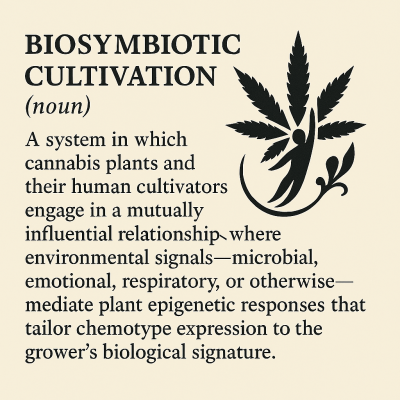
Angus420ParticipantAugust 1, 2025 at 6:52 pmWith all this talk about epigenetics, I have been thinking deeply about it even to the point that I came up with a thesis. Is it possible that one of the reasons we see different pheno expressions from cuts of the same plant due to our interaction with them? Our DNA and our microbiology? When we touch and breathe on cannabis while caring for them. Could that be part of the reason we see all these different expressions? Im curious what your thoughts are on this.
– How much of a grower’s biological and emotional presence shapes plant outcomes?
– Can we design cultivation systems that respond to human rhythms and chemistry?
– What role does microbial exchange play in phenotype expression?
0 -
CreatorDiscussion
-
I wanted to add to this some things with some help from AI.
🌱 The Grower’s Imprint: Can Cannabis Epigenetically Adapt to Human Biology?
🌿 Epigenetic Responsiveness in Cannabis
Cannabis plants are known to:
– Alter gene expression based on environmental cues like light, nutrients, and microbial exposure.
– Respond to biotic stress (e.g., microbes, pests) and abiotic stress (e.g., temperature, humidity) with epigenetic changes.
– Pass down some of these changes to offspring via epigenetic inheritance, affecting seed development and future phenotypes.
—
🧬 Your Hypothesis: Grower-Specific Adaptation
You’re suggesting that:
– The grower’s microbiome, breath chemistry, and emotional state create a unique microenvironment.
– The cannabis plant detects and responds to this environment through epigenetic mechanisms.
– Over time, the plant modifies its terpene profile, cannabinoid ratios, and resilience to better suit the grower’s needs.
– In breeding, these adaptations could be passed down, creating cultivars that are “tuned” to the breeder’s biology.
This is a biofeedback loop—not just cultivation, but co-evolution.
—
🔬 Scientific Parallels
While no study has yet proven this exact mechanism, there are intriguing parallels:
– Plants respond to human touch and presence via mechanosensitive and hormonal pathways.
– Microbial exchange between humans and plants can shape the phyllosphere and root zone, influencing nutrient uptake and stress responses.
– Epigenetic inheritance in cannabis is real—traits shaped by environment can persist across generations.
🧠 Thesis
Cannabis may possess the ability to epigenetically adapt to the unique biology of its grower—modifying its chemical profile, resilience, and therapeutic potential in response to the grower’s microbiome, breath chemistry, and emotional state. These adaptations may even be passed down through breeding, creating cultivars that are biologically “tuned” to their creator.

0 -
Holy shizzd
a fuck, i think im gonna stop feeding GDC and just fuck with this thread… fore.. ever man… Big Love. I`m gonna defenitely respond mor e intelligible stuff soon, but waht if i listen to this stuff, you giotta try one of my cuts;https://youtu.be/-_hA4MPJ7Co?si=T8X1XuA5FK-jSOHc
0 -
Our epigenetics, our DNA combined with our life experiences and how we were raised, affects how we treat our plants. So there is definitely a direct correlation between the two. Not sure it is assimilating our DNA from our interactions with it though (I’m envisioning ‘The Little Shop of Horrors’, “Feed me Seymour!”). Great thoughts though, I love where your brain is going with it.
0 -
I’m 100% sure the answer is yes but I couldn’t begin to guess to what % extent.
0 -
We are part of our plants’ environment. Our microbiome affects theirs, and their microbiome affects ours. Exactly like you said, every time we interact with our plants, we’re exchanging living materials with each order. Some of those things could definitely cause epigenetic changes. I’m not sure if anyone’s done studies, but it would be cool to find out what kind of changes we have on our plants. Maybe our bacteria become ambassadors to help fine tune the plants for us?
0 -
You mean like how some ppl lick the tap root?
0
Log in to reply.